ActivityPub Federation
NeoDB federates over ActivityPub (server-to-server). The implementation is based
on Takahē, extended so that NeoDB instances can
exchange catalog, list and review data on top of ordinary Fediverse posts.
General ActivityPub servers can consume those posts as plain Note / Article
objects and ignore the NeoDB-specific extensions; NeoDB peers read the extensions
to reconstruct the underlying marks, ratings, reviews and lists.
For NeoDB's ATProto (Bluesky) behaviour, see atproto.md.
Federation topology
How NeoDB instances interconnect with each other, the Fediverse, and the Atmosphere:
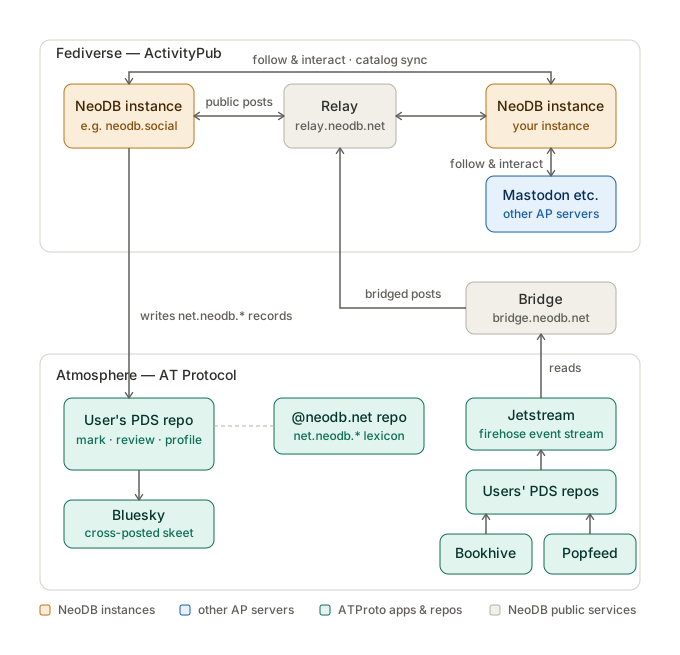
Supported protocols and standards
- ActivityPub (server-to-server)
- WebFinger
- HTTP Signatures
- NodeInfo
Supported FEPs
NodeInfo
A NeoDB instance can be identified from its user agent string
(NeoDB/x.x (+https://example.org)) and the protocols array in its NodeInfo,
e.g. https://neodb.social/nodeinfo/2.0/:
{
  "version": "2.0",
  "software": {
    "name": "neodb",
    "version": "0.10.4.13",
    "repository": "https://github.com/neodb-social/neodb",
    "homepage": "https://neodb.net/"
  },
  "protocols": ["activitypub", "neodb"],
  "metadata": {
    "nodeEnvironment": "production",
    "neodbFeatures": ["catalog.search"],
    "neodbFeatureParams": {
      "catalog.search": {"endpoint": "https://neodb.social/api/catalog/search"}
    }
  }
}
A NeoDB instance treats a domain as a NeoDB peer when its NodeInfo has neodb
in protocols and nodeEnvironment of production.
Features
metadata.neodbFeatures lists the NeoDB features a server offers to peers;
metadata.neodbFeatureParams holds their parameters, keyed by token. A server
offers exactly what it lists: no list, or [], means none. Tokens are
lowercase dotted strings whose meaning never changes; unknown tokens are
ignored.
| Token | Meaning |
|---|---|
catalog.search |
Peers may send catalog searches to neodbFeatureParams["catalog.search"].endpoint (default https://<domain>/api/catalog/search; used only when it is https on the server's domain or a subdomain) with the request and response shape of /api/catalog/search: query, page (20 items per page) and optional category; data is a list of items with url (a path on the server's domain), display_title, brief, cover_image_url and external_resources (a list). NeoDB advertises it unless Allow incoming federated search is off, or the instance runs in debug or without federation; it searches only peers that advertise it. |
Extended activities
NeoDB adds two fields to the Note activity (and to Article, which carries
reviews):
relatedWithis a list of NeoDB-specific activities associated with the post. For each entry,idandhrefare unique links to that activity,withRegardTolinks to the catalog item,attributedTolinks to the user, andtypeis one of:Status—statusis one ofcomplete,progress,wishlist,droppedRating—valueis the grade (integer 1-10);worstis always 1,bestalways 10Comment—contentis the comment textReview—nameis the title,contentthe body,mediaTypeistext/markdown(see Review)Note—nameis the title,contentthe note text (older instances sent the title astitle; it is still emitted alongsidename, and readers accept either)Shelf— the lightweight envelope of a Collection or Shelf (see Collections and shelves)
tagcarries the catalog items referenced by the activity. Each item'stypeis one ofEdition,Movie,TVShow,TVSeason,TVEpisode,Album,Game,Podcast,PodcastEpisode,Performance,PerformanceProduction, andhreflinks to the item.
This is a pragmatic way to pass extra information between NeoDB instances; other ActivityPub servers simply ignore it. Suggestions for improvement are welcome.
Review
A review rides in a post of type: Article. The outer object carries name,
content (HTML), source ({content, mediaType: text/markdown}) and summary
for general AP clients; the full Review activity sits in relatedWith[0] with
the raw markdown body and withRegardTo for NeoDB peers.
Example
A post from neodb.social carrying a Status, Comment and Rating:
{
  "@context": ["https://www.w3.org/ns/activitystreams", {
    "blurhash": "toot:blurhash",
    "Emoji": "toot:Emoji",
    "focalPoint": {
      "@container": "@list",
      "@id": "toot:focalPoint"
    },
    "Hashtag": "as:Hashtag",
    "manuallyApprovesFollowers": "as:manuallyApprovesFollowers",
    "sensitive": "as:sensitive",
    "toot": "http://joinmastodon.org/ns#",
    "votersCount": "toot:votersCount",
    "featured": {
      "@id": "toot:featured",
      "@type": "@id"
    }
  }, "https://w3id.org/security/v1"],
  "id": "https://neodb.social/@april_long_face@neodb.social/posts/380919151408919488/",
  "type": "Note",
  "relatedWith": [{
    "id": "https://neodb.social/p/5oyF0qRx96mKKmVpFzHtMM",
    "type": "Status",
    "status": "complete",
    "withRegardTo": "https://neodb.social/movie/7hfF7d0aFMaqHpFjUpq4zR",
    "attributedTo": "https://neodb.social/@april_long_face@neodb.social/",
    "href": "https://neodb.social/p/5oyF0qRx96mKKmVpFzHtMM",
    "published": "2024-11-17T10:16:42.745240+00:00",
    "updated": "2024-11-17T10:16:42.750917+00:00"
  }, {
    "id": "https://neodb.social/p/47cJnbQTkbSSN2izLwQMjo",
    "type": "Comment",
    "withRegardTo": "https://neodb.social/movie/7hfF7d0aFMaqHpFjUpq4zR",
    "attributedTo": "https://neodb.social/@april_long_face@neodb.social/",
    "content": "Broadway cin\u00e9math\u00e8que, at least I laughed hard.",
    "href": "https://neodb.social/p/47cJnbQTkbSSN2izLwQMjo",
    "published": "2024-11-17T10:16:42.745240+00:00",
    "updated": "2024-11-17T10:16:42.777276+00:00"
  }, {
    "id": "https://neodb.social/p/3AyYu974qo6OU09AAsPweQ",
    "type": "Rating",
    "best": 10,
    "value": 7,
    "withRegardTo": "https://neodb.social/movie/7hfF7d0aFMaqHpFjUpq4zR",
    "worst": 1,
    "attributedTo": "https://neodb.social/@april_long_face@neodb.social/",
    "href": "https://neodb.social/p/3AyYu974qo6OU09AAsPweQ",
    "published": "2024-11-17T10:16:42.784220+00:00",
    "updated": "2024-11-17T10:16:42.786458+00:00"
  }],
  "attributedTo": "https://neodb.social/@april_long_face@neodb.social/",
  "content": "<p>\u770b\u8fc7 <a href=\"https://neodb.social/~neodb~/movie/7hfF7d0aFMaqHpFjUpq4zR\" rel=\"nofollow\">\u963f\u8bfa\u62c9</a> \ud83c\udf15\ud83c\udf15\ud83c\udf15\ud83c\udf17\ud83c\udf11  <br>Broadway cin\u00e9math\u00e8que, at least I laughed hard.</p><p><a href=\"https://neodb.social/tags/\u6211\u770b\u6211\u542c\u6211\u8bfb/\" class=\"mention hashtag\" rel=\"tag\">#\u6211\u770b\u6211\u542c\u6211\u8bfb</a></p>",
  "published": "2024-11-17T10:16:42.745Z",
  "sensitive": false,
  "tag": [{
    "type": "Hashtag",
    "href": "https://neodb.social/tags/\u6211\u770b\u6211\u542c\u6211\u8bfb/",
    "name": "#\u6211\u770b\u6211\u542c\u6211\u8bfb"
  }, {
    "type": "Movie",
    "href": "https://neodb.social/movie/7hfF7d0aFMaqHpFjUpq4zR",
    "image": "https://neodb.social/m/item/doubanmovie/2024/09/13/a30bf2f3-4f79-43ef-b22f-58ebc3fd8aae.jpg",
    "name": "Anora"
  }],
  "to": ["https://www.w3.org/ns/activitystreams#Public"],
  "updated": "2024-11-17T10:16:42.750Z",
  "url": "https://neodb.social/@april_long_face/posts/380919151408919488/"
}
Collections and shelves
NeoDB has two kinds of item list:
- Collection — a user-curated list.
- Shelf — a per-status list: Wishlist, Progress, Complete or Dropped.
Both federate with the same wire shape, type: "Shelf". The type is deliberately
not Collection, to avoid colliding with the ActivityStreams Collection type:
an AP-aware peer must not mistake a NeoDB list for a generic AS collection.
Announcement and discovery
When a Collection is created or updated, NeoDB publishes a Note post whose
relatedWith[0] carries the lightweight Shelf envelope described below. Shelves
are not announced this way — the per-mark Status posts already cover that
activity — so they are discovered by following a user, fetching a shelf URL
directly, or pasting its link.
Lightweight envelope
The envelope never inlines the member list; it exposes totalItems and
first / last links to a paginated items endpoint:
{
  "id":           "https://server/collection/<uuid>",
  "type":         "Shelf",
  "name":         "<title or shelf label>",
  "content":      "<description in markdown, Collection only>",
  "mediaType":    "text/markdown",
  "attributedTo": "<actor uri>",
  "published":    "...",
  "updated":      "...",
  "totalItems":   <int>,
  "first":        "https://server/.../items?page=1",
  "last":         "https://server/.../items?page=K",

  "shelfType":    "wishlist|progress|complete|dropped",  // Shelf only
  "query":        "<search query>"                       // dynamic Collection only
}
shelfType distinguishes the two kinds: present means Shelf, absent means
Collection.
The envelope id is the human-facing URL and is not guaranteed to dereference as
ActivityPub. Only the items endpoint is guaranteed to serve
application/activity+json, so follow first / next there to read members.
Items endpoint
Each list exposes <id>/items as a standard OrderedCollection:
- With no
?pageparameter it returns the collection envelope (id,type,totalItems,first,last). - With
?page=Nit returns oneOrderedCollectionPage(id,partOf,orderedItems, andnext/prevwhere applicable).
// <id>/items
{
  "id":         "https://server/collection/<uuid>/items",
  "type":       "OrderedCollection",
  "totalItems": <int>,
  "first":      "https://server/collection/<uuid>/items?page=1",
  "last":       "https://server/collection/<uuid>/items?page=K"
}

// <id>/items?page=2
{
  "id":           "https://server/collection/<uuid>/items?page=2",
  "type":         "OrderedCollectionPage",
  "partOf":       "https://server/collection/<uuid>/items",
  "next":         "https://server/collection/<uuid>/items?page=3",
  "prev":         "https://server/collection/<uuid>/items?page=1",
  "orderedItems": [ /* ShelfItem entries */ ]
}
Pages hold up to 100 entries; the total length is unbounded, so walk next until
it is absent.
ShelfItem entries
Each orderedItems entry is a ShelfItem:
{
  "type":         "ShelfItem",
  "withRegardTo": "https://server/book/<uuid>",  // catalog item, always present
  "post":         "https://server/@alice/123",   // Shelf only: the mark's Status post
  "commentText":  "..."                           // Collection only: per-item note
}
withRegardTo links to the catalog item; dereferencing it returns an AP catalog
object (Edition, Movie, TVShow, Album, ...). For shelves, post links to
the mark's Status post, letting a peer fetch the associated mark, rating,
comment and review in a single request without following the user first.
Fetching
Requests to the items endpoint should be HTTP-signed. NeoDB signs its outbound fetches as the instance actor, using the canonical form Takahē and Mastodon use:
- Algorithm
rsa-sha256. - Signed headers exactly
(request-target) host date. Daterequired, within a 300-second skew window.- GET only — no request body or digest.
Public lists are served to any caller, including unsigned requests. Followers-only and private lists require a signature from an actor entitled to see them.
Interoperability notes
- Follow the origin. Dereference a list at its original
idon the origin instance. NeoDB holds only possibly-stale mirrors of remote lists and does not re-serve them as ActivityPub. - Public lists only, for now. Cross-instance member sync is reliable only for public lists; followers-only members do not yet round-trip between instances. The announcement Note still reaches followers, so the list is mirrored even when its members lag.
- Not yet federated. Tag lists and collaborative collections are local-only.
The
postlink onShelfItementries is emitted but not yet consumed automatically on ingest.
BookWyrm reviews
BookWyrm sends a review to non-BookWyrm servers as an Article. NeoDB keeps
the post in the timeline and also maps it to a remote Review and Rating on
the reviewed book:
inReplyToBooknames the BookWyrm Edition. NeoDB imports it as a catalog source (IdType.BookWyrm, the canonicalhttps://<host>/book/<n>URL as id value). The edition's ISBN, Open Library and Goodreads ids are lookup ids, so the review lands on an existing item that shares one; only a book with no match creates a new Edition from BookWyrm's metadata.rating, 0.5 to 5 stars in halves, becomes a Rating of stars × 2. Its remote id is the review id plus#rating.nameis the translatedReview of "<book>" (<n> stars): <headline>. The headline becomes the Review title; when it is missing BookWyrm rendersNone, and NeoDB then uses the name without: None.- A review marked
sensitiveadds the Rating only, because a Review has no content warning. The text stays on the post. - Edits and deletes take the same path as other remote pieces.
Comments, quotations and rating-only statuses arrive as Note and are not
mapped. Takahe hands every remote Article to NeoDB, which maps only those
with relatedWith or inReplyToBook.
A BookWyrm book URL is fetched only from a known BookWyrm server: a peer domain
whose nodeinfo names bookwyrm, or the server of the review's own author,
which covers an instance whose nodeinfo NeoDB has not fetched yet. Servers in
secure mode get a GET signed by the instance actor when an anonymous GET is
refused. FediverseInstance (the remote NeoDB fallback) refuses BookWyrm hosts
and payloads without category, so a BookWyrm URL never becomes a fedi
resource. Pasting a BookWyrm book URL into "add from URL" imports it the same
way.
BookWyrm serves editions and works under the same /book/<n> path, so one
site handles both and picks the model from the fetched type. A Work becomes
a catalog Work, with its Open Library work id as lookup id. An Edition names
its Work as parent, so importing an edition also imports and links the work.
Reviews attach to editions only.
Reviews received before this mapping existed are still stored as posts. To link them, run:
neodb-manage journal bookwyrm-reviews        # report only
neodb-manage journal bookwyrm-reviews --fix  # link reviews
--delay sets the seconds between reviews (default 1), because some instances
refuse bursts. Before that, a one-off job queued by the journal migration
0021_register_bookwyrm_peers registers the BookWyrm servers listed on
FediDB as peer domains with a placeholder nodeinfo;
takahe then fetches their real nodeinfo.
Relay
NeoDB instances may share public ratings and reviews through a default relay,
currently https://relay.neodb.net, which propagates public activities and
catalog information between instances. Instance operators can turn this off in
admin settings.